
Learn what the IBM Data Analytics Professional Certificate offers, who it’s for, what you’ll learn, and whether it’s worth taking in 2026
If you’ve been exploring ways to build a career in data analytics, chances are you’ve come across the IBM Data Analytics Professional Certificate. It’s one of the most talked-about online programmes for beginners, and for good reason. With companies across industries relying more on data to make decisions, many people are wondering whether this certificate is a smart first step or just another online credential that looks good on paper.
The answer isn’t as simple as yes or no.
Some learners enrol because they want to change careers. Others are recent graduates looking to strengthen their CVs before applying for their first job. There are also professionals in administration, finance, marketing, and customer service who hope that learning data analytics will open the door to new opportunities.
Before investing your time and money, it’s worth understanding exactly what this programme offers, what you’ll learn, and whether it matches your career goals. Rather than focusing on marketing claims, this guide takes a closer look at the course itself and what prospective learners should realistically expect.
Table of Contents
What Is the IBM Data Analytics Professional Certificate?
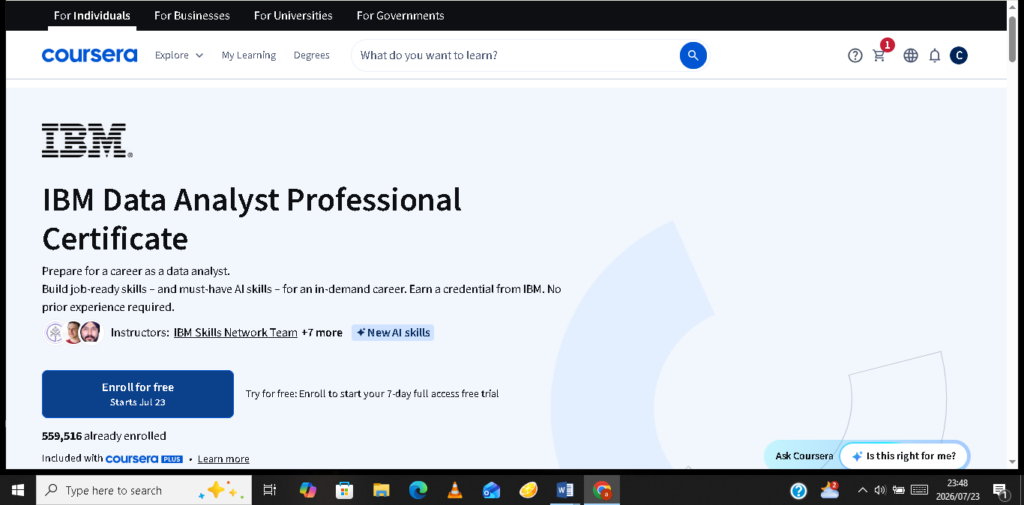
The IBM Data Analytics Professional Certificate is a beginner-friendly programme available through Coursera. It was developed by IBM to help learners build practical data analytics skills without requiring previous experience in programming, statistics, or computer science.
Instead of teaching isolated concepts, the programme introduces learners to the complete data analytics process. From collecting and cleaning data to analysing information and presenting findings, each course builds on the previous one to create a structured learning path.
Because the programme is self-paced, learners can study around work, university, or other commitments. Some people complete it within a few months by studying regularly, while others take longer depending on their schedule.
One reason the certificate attracts so much attention is that it doesn’t assume you’re already an expert. The lessons begin with the fundamentals before gradually introducing more technical skills.
What Will You Learn During the Programme?
Many people ask whether the programme only teaches theory or whether it includes practical skills that can be used in the workplace.
The curriculum focuses heavily on developing skills that are commonly used in entry-level data analytics roles.
Early modules introduce the foundations of data analytics, including understanding different types of data, identifying business problems, and recognising how organisations use data to support decision-making.
As the programme progresses, learners begin working with tools that frequently appear in job descriptions.
Excel
Although many people think of Excel as a simple spreadsheet application, it remains one of the most widely used tools in business environments.
The programme introduces learners to organising datasets, performing calculations, filtering information, creating charts, and analysing trends. These are practical skills that can be useful in administration, finance, operations, and many other fields.
SQL
SQL is another core component of the programme.
Since organisations often store information in databases rather than spreadsheets, knowing how to retrieve and organise data is an important skill for aspiring analysts.
Learners are introduced to writing basic SQL queries, filtering records, sorting information, and combining datasets. While the course doesn’t expect complete beginners to become database experts overnight, it provides a solid starting point.
Python
One question frequently asked online is whether the programme teaches Python.
The answer is yes.
However, the Python content is introduced gradually rather than assuming learners already know how to code.
Participants learn how Python can be used to clean data, perform analysis, and automate repetitive tasks. The focus remains on practical application rather than advanced software development.
For many beginners, this is often their first exposure to programming, making the gradual learning approach particularly valuable.
Data Visualisation
Collecting data is only part of the process.
Being able to communicate findings clearly is equally important.
Throughout the programme, learners create graphs, charts, and visual reports designed to help others understand patterns within data.
These skills are especially relevant because employers often expect analysts to present information in a way that non-technical colleagues can understand.
Is the Programme Suitable for Complete Beginners?
This is probably the most common question prospective learners ask.
The encouraging news is that the programme was designed with beginners in mind.
You don’t need previous experience in coding, mathematics beyond basic concepts, or professional data analysis.
That doesn’t mean the programme is effortless.
Like any technical subject, there will be moments when new concepts require patience and consistent practice.
Learners who dedicate time each week to completing exercises and revisiting difficult topics are generally more likely to build lasting skills than those who rush through videos simply to earn a certificate.
Approaching the programme with curiosity instead of focusing only on the final credential often leads to a much more rewarding learning experience.
How Long Does It Really Take to Finish?
The official estimate gives learners a general idea of the study commitment, but real experiences vary.
Someone studying for an hour each evening may complete the programme within a few months.
Others who already have experience using Excel or working with data might progress more quickly because some concepts feel familiar.
On the other hand, learners balancing full-time employment, family responsibilities, or university studies may need additional time.
Because the programme is self-paced, there is flexibility to pause and resume without feeling pressured to keep up with a fixed classroom schedule.
Rather than aiming to finish as quickly as possible, it’s often better to focus on understanding the material thoroughly.
The practical skills developed along the way are likely to be far more valuable than completing the certificate in record time.
Does the Certificate Carry Value?
A common misconception is that employers hire candidates simply because they possess an online certificate.
In reality, employers usually look at the bigger picture.
The IBM Data Analytics Professional Certificate can demonstrate initiative and a willingness to learn, particularly for candidates entering the field or changing careers.
However, most hiring managers also want evidence that applicants can apply what they’ve learned.
This is why practical exercises and projects completed during the programme are often just as important as the certificate itself.
For many learners, the programme becomes a starting point rather than the final destination. Building a portfolio, practising with real datasets, and continuing to develop technical skills after completing the certificate can strengthen future job applications.
Can the IBM Data Analytics Professional Certificate Help You Find a Job?
One of the biggest questions asked by learners on discussion forums is whether completing the IBM Data Analytics Professional Certificate is enough to land a job.
The honest answer is that the certificate can improve your chances, but it is not a guarantee of employment.
Many entry-level data analytics roles require applicants to demonstrate problem-solving skills, familiarity with data tools, and the ability to explain insights clearly. This programme helps learners build that foundation, but employers often want to see how those skills have been applied.
For example, if you can show a portfolio containing dashboards, SQL queries, Python notebooks, or data visualisations you’ve created, you may stand out more than someone who only lists the certificate on their CV.
In other words, the certificate opens the door to learning, but your projects and continued practice help you walk through it.
Are the Practical Projects Worth It?
This is another question that appears frequently in online discussions, especially among people deciding between IBM and other data analytics programmes.
The programme includes hands-on activities that encourage learners to work with datasets instead of simply watching instructional videos. These projects are designed to reinforce concepts taught throughout the lessons and give learners an opportunity to practise using tools such as Excel, SQL, Python, and data visualisation software.
While the projects may not fully replicate the complexity of analysing data in a large organisation, they do provide valuable experience for beginners. Completing them carefully can help build confidence before moving on to more advanced personal or workplace projects.
If you’re serious about entering the field, consider expanding on what you’ve learned by analysing publicly available datasets after completing the programme. This shows initiative and helps develop problem-solving skills beyond the course material.
Is the IBM Certificate Better Than Google’s Data Analytics Certificate?
This comparison comes up regularly, but there isn’t a universal winner.
The IBM programme places considerable emphasis on technical tools such as Python and SQL while also introducing broader data analytics concepts. Google’s programme, on the other hand, focuses strongly on the day-to-day workflow of data analysts and uses different tools in some modules.
Choosing between them depends largely on your learning goals rather than trying to find the “best” certificate.
If your goal is to gain a solid introduction to technical data analysis tools while learning from a well-known technology company, IBM’s programme is a strong option.
Some learners even complete both programmes over time to broaden their knowledge, although that isn’t necessary for everyone.
Do Employers Recognise the IBM Data Analytics Professional Certificate?
IBM is a globally recognised technology company, and that recognition can add credibility to the certificate.
However, employers don’t usually make hiring decisions based on the issuing organisation alone.
Recruiters often evaluate candidates based on several factors, including relevant skills, practical experience, communication abilities, and how well they can solve problems. If you’re curious about how hiring managers generally assess online learning credentials, it’s worth understanding what employers really think about online certificates before relying on any certificate alone.
For someone with little or no professional experience in data analytics, the certificate can demonstrate commitment to learning. Combined with a strong CV, a portfolio of projects, and preparation for interviews, it can strengthen an application.
Rather than viewing it as a shortcut to employment, it’s better to see it as one piece of a broader career development plan.
Is the Monthly Subscription Worth Paying?
Since the programme is delivered through Coursera, learners often wonder whether the subscription cost is worthwhile.
The answer depends on how committed you are to completing the programme.
Because Coursera charges a recurring subscription for many professional certificates, finishing efficiently can reduce the overall cost. Learners who follow a consistent study schedule may spend less than those who frequently pause their studies.
Before enrolling, it’s also worth checking whether financial aid or promotional offers are available through the platform if cost is a concern.
Whatever option you choose, make sure you have enough time to study consistently. Paying for a course but rarely logging in is unlikely to provide good value.
Who Should Consider This Programme?
The IBM Data Analytics Professional Certificate may be suitable for:
- Beginners exploring a career in data analytics.
- University graduates looking to strengthen their technical skills.
- Professionals who regularly work with spreadsheets and want to improve their analytical abilities.
- Career changers interested in learning data-related tools.
- Small business owners who want to make better use of business data.
On the other hand, experienced data analysts or professionals already comfortable with SQL, Python, and data visualisation may find that parts of the programme cover material they already know.
Tips for Getting the Most Out of the Programme
Completing every lesson is only part of the learning journey. To gain more value from the programme:
- Practise using Excel, SQL, and Python outside the course exercises.
- Keep notes explaining how different analytical techniques solve real problems.
- Build a small portfolio using public datasets from topics that interest you.
- Revisit challenging lessons instead of skipping ahead.
- Update your CV and LinkedIn profile only after you genuinely understand the skills you’ve developed.
Consistent practice often has a greater long-term impact than rushing to earn a certificate.
Things to Keep in Mind
The IBM Data Analytics Professional Certificate offers a structured introduction to one of today’s fastest-growing fields. It combines technical skills with practical exercises in a way that is accessible to beginners while encouraging learners to think critically about how data can solve real-world problems.
Its greatest strength is that it doesn’t simply introduce software—it helps learners understand the process of collecting, analysing, and communicating data. That foundation can be valuable for those considering a career in analytics or looking to strengthen their existing professional skills.
Like any online learning programme, the certificate delivers the most value when paired with curiosity, consistent practice, and a willingness to continue learning after the final module. Completing the programme is an achievement, but applying those skills to real projects is what ultimately helps transform knowledge into career opportunities.
If you’re looking for a beginner-friendly introduction to data analytics and are prepared to invest time in practising what you learn, the IBM Data Analytics Professional Certificate is a programme worth considering.