
Thinking about studying cybersecurity in South Africa? Learn about courses, Maths Literacy requirements, career paths, salaries, certifications, where to study and how to start your cybersecurity career.
Every day, someone in South Africa receives a message that looks harmless. It might claim to be from a bank, a courier company or even a government department. Within minutes, personal information is stolen, money disappears from an account or a business loses access to its systems. Most people only realise what happened after the damage is done.
Behind the scenes, cybersecurity professionals are the people working to stop those attacks before they happen.
If you’ve been thinking about studying cybersecurity but aren’t sure where to start, you’re not alone. Thousands of South Africans search for answers every month. Some wonder whether Maths Literacy is enough. Others ask if they need to know coding, whether a degree is necessary or if online courses can really lead to a career.
Those are fair questions—and they’re often answered with confusing or incomplete information.
This guide brings everything together in one place. Whether you’re a Grade 12 learner, a TVET College student, someone looking for a career change or simply curious about technology, here’s what you need to know before choosing cybersecurity as your next step.
Table of Contents
Why Cybersecurity Has Become One of South Africa’s Most Important Careers
Think about how much of your daily life depends on the internet.
You use online banking.
You shop online.
Your employer stores employee records digitally.
Hospitals keep patient information electronically.
Universities manage student data through online portals.
Every one of these systems can become a target for cybercriminals.
As businesses continue moving their operations online, protecting digital information is no longer optional. A single cyberattack can cost organisations millions of rand, damage customer trust and interrupt essential services.
That’s why cybersecurity professionals have become some of the most sought-after specialists across banking, healthcare, retail, telecommunications, mining, government and technology.
The demand isn’t limited to South Africa either. Cybersecurity is one of the few careers where your skills can open doors to opportunities across the world, including remote jobs for international companies.
So, What Does Someone in Cybersecurity Actually Do?
Many people imagine hackers sitting in dark rooms wearing hoodies.
The reality is very different.
Cybersecurity is about protecting computers, networks and information from people who want to steal, damage or misuse them.
Depending on your role, you might spend your day:
- Monitoring computer networks for suspicious activity
- Investigating security alerts
- Helping organisations recover after cyberattacks
- Testing systems for weaknesses before criminals find them
- Educating employees about phishing scams
- Setting up security software
- Managing passwords and access controls
- Developing strategies to keep company information safe
Some professionals specialise in defending systems, while others are hired to legally test security by attempting to break into networks. These ethical hackers help organisations identify weaknesses before criminals can exploit them.
No two days are exactly the same, which is one reason many people enjoy working in this field.
Can I Study Cybersecurity If I Took Maths Literacy?
This is one of the biggest questions asked by South African learners, and unfortunately, there isn’t a single yes-or-no answer.
Here’s the reality.
Some universities offering degree programmes in Information Technology or Computer Science require Pure Mathematics because of the academic demands of their courses.
However, many private colleges, online training providers and certain diploma or higher certificate programmes may accept applicants with Maths Literacy, provided they meet the institution’s admission requirements.
That means having Maths Literacy does not automatically prevent you from building a cybersecurity career.
What matters is choosing the right learning pathway.
If your goal is to work in cybersecurity rather than become a software engineer or computer scientist, practical skills and recognised industry certifications often play a significant role alongside formal qualifications.
Before applying, always check the admission requirements of the institution you’re interested in rather than assuming you’re not eligible.
Many students miss opportunities simply because they never verify the actual entry requirements.
Do I Need to Be a Computer Genius?
Not at all.
One of the biggest myths surrounding cybersecurity is that only exceptionally gifted programmers can succeed.
The truth is that cybersecurity combines technical knowledge with problem-solving, curiosity and attention to detail.
If you enjoy figuring out how things work, solving puzzles or learning new technology, you already have qualities that can help you succeed.
Like any career, the skills develop over time.
Nobody starts by defending multinational companies on their first day.
Professionals begin with the basics and gradually build their knowledge through practice and experience.
Is Coding Required?
Another question that appears repeatedly in online discussions is whether coding is mandatory.
The answer depends on your career path.
Some cybersecurity jobs involve very little programming.
Others require a solid understanding of scripting languages like Python or PowerShell.
If you’re starting from scratch, don’t let coding intimidate you.
Many successful cybersecurity professionals learned programming after they entered the industry rather than before.
Think of coding as a valuable tool rather than the first obstacle standing in your way.
What Subjects Should You Enjoy?
While excellent marks are always helpful, cybersecurity is less about memorising information and more about understanding systems.
Students who usually enjoy these subjects often adapt well:
- Information Technology
- Computer Applications Technology (CAT)
- Mathematics
- Maths Literacy (depending on the institution)
- Physical Sciences
- Engineering Graphics and Design
- Business Studies
However, these are not strict requirements for every learning pathway.
Your willingness to keep learning is often more important than your Grade 12 subject combination.
Where Can You Learn Cybersecurity?
One of the best things about cybersecurity is that learning doesn’t have to begin with an expensive degree.
Some of the world’s leading technology companies now provide high-quality online training that beginners can complete from home.
If you’re completely new, these platforms are excellent starting points:
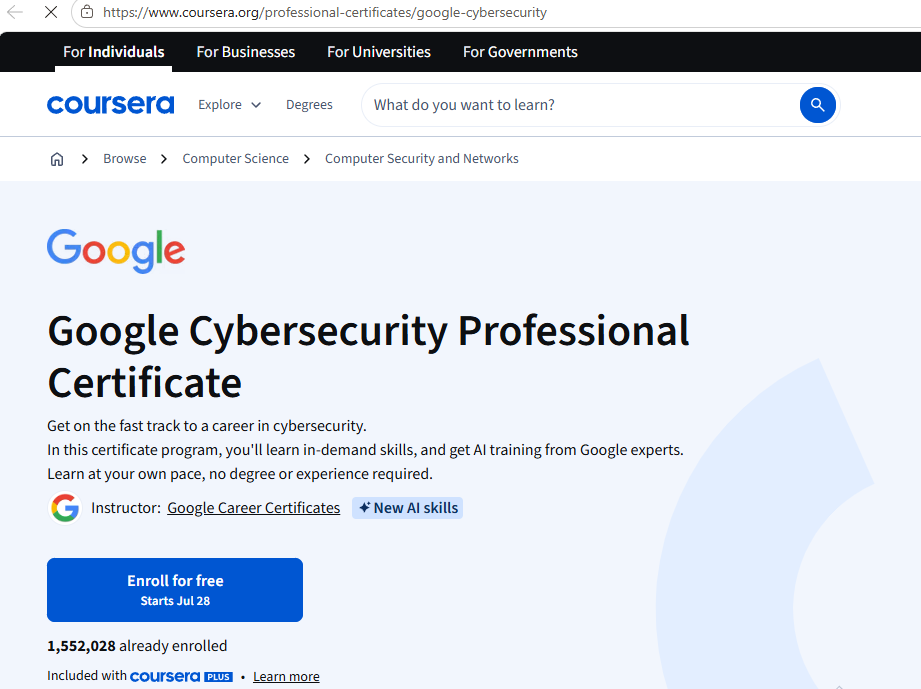
Google Cybersecurity Professional Certificate
Designed for beginners with no previous experience, this course introduces networking, operating systems, security concepts and practical tools used in the workplace.
If you’d like to enrol, visit the official Google Career Certificates website on Coursera to explore the Cybersecurity Professional Certificate, review the course content and see whether financial aid or free trial options are available before registering.
Microsoft Learn
Microsoft offers free learning paths covering security fundamentals, cloud security and identity management.
Many lessons include hands-on exercises that help you build practical skills rather than simply reading theory.
Cisco Networking Academy
Cisco has built a strong reputation for networking education.
Their free introductory cybersecurity courses explain essential concepts in simple language, making them suitable for beginners.
TryHackMe
Unlike traditional online courses, TryHackMe allows learners to practise inside virtual computer environments.
Instead of watching videos all day, you solve challenges and learn by doing.
Many beginners say this practical approach helped them understand cybersecurity far better than textbooks alone.
Hack The Box Academy
Once you’ve mastered the basics, Hack The Box introduces more advanced scenarios that simulate real-world security challenges.
It’s popular among aspiring ethical hackers and penetration testers.
Can Free Online Courses Really Help You Find a Job?
This is where expectations need to be realistic.
A free certificate by itself rarely guarantees employment.
What employers often want to see is evidence that you can actually apply what you’ve learned.
Imagine two candidates.
One has completed five online courses but has never practised.
The other completed two courses, built a home cybersecurity lab, documented projects on GitHub and participated in beginner security challenges.
Many hiring managers would be more interested in the second candidate because they demonstrated practical ability.
Certificates open doors.
Projects convince employers.
The Beginner Mistake That Delays Many Careers
A surprising number of beginners spend months collecting certificates without developing practical skills.
Cybersecurity is similar to learning to drive.
Reading the learner’s manual is important.
Actually driving the vehicle is what builds confidence.
As you learn, challenge yourself to:
- Set up a virtual machine.
- Explore Linux.
- Learn basic networking.
- Understand how firewalls work.
- Practise identifying phishing emails.
- Complete beginner labs regularly.
Small projects completed consistently often make a stronger impression than a long list of certificates.
The Career Paths You Can Follow in Cybersecurity
One of the biggest misconceptions is that cybersecurity is a single job. In reality, it’s an industry with dozens of career paths. As you gain experience, you can choose to specialise in the area that matches your interests.
Here are some of the most common roles you’ll come across:
Security Analyst
This is where many professionals begin. Security analysts monitor networks, investigate suspicious activity and respond to incidents before they become major problems. They are often the first line of defence against cyberattacks.
SOC (Security Operations Centre) Analyst
A SOC Analyst works in a dedicated security team that monitors systems around the clock. If unusual activity is detected, they investigate it and decide on the appropriate response.
Penetration Tester (Ethical Hacker)
Instead of waiting for criminals to attack, ethical hackers are hired to legally test an organisation’s systems. They think like hackers—but work to improve security rather than exploit it.
Cloud Security Specialist
As more businesses move their operations to cloud platforms like Microsoft Azure and AWS, specialists who understand cloud security are becoming increasingly valuable.
Digital Forensics Investigator
When a cyberattack happens, someone has to determine how it occurred and gather digital evidence. That’s the role of a digital forensics investigator.
Security Consultant
Consultants advise organisations on improving their security posture, reducing risks and complying with regulations. Many eventually work independently after gaining experience.
The encouraging part is that you don’t have to decide on your speciality immediately. Most professionals start in an entry-level role and discover their preferred path as they gain experience.
Can You Get a Job Without a Degree?
This is another question that appears repeatedly in online discussions.
The answer is yes—but there are conditions.
Many employers still value degrees, particularly for graduate programmes and larger organisations. However, the cybersecurity industry is also known for recognising practical skills, professional certifications and hands-on experience.
Someone who has built a portfolio, completed respected certifications and can demonstrate real-world problem-solving may be more competitive than someone who has only academic qualifications.
That doesn’t mean degrees are unnecessary—they remain an excellent option if you have the opportunity to pursue one.
Instead, think of your career as a combination of:
- Formal education (where possible)
- Industry certifications
- Practical projects
- Continuous learning
The technology industry changes quickly, so learning rarely stops after graduation.
Where Can You Study Cybersecurity in South Africa?
South Africa offers several pathways into cybersecurity.
Depending on your academic results and career goals, you may consider:
Universities
Many universities offer qualifications in:
- Computer Science
- Information Technology
- Information Systems
- Cybersecurity (where available)
- Computer Engineering
Some institutions introduce cybersecurity during undergraduate studies before offering specialised postgraduate programmes.
Universities of Technology
Many Universities of Technology provide practical IT qualifications that include networking, systems administration and security-related modules.
Private Colleges
Several accredited private colleges offer diplomas and certificates in networking, cybersecurity and cloud computing.
Admission requirements often differ from universities, making them another option for students who don’t meet university entrance criteria.
Online Learning Platforms
For those unable to study full-time, online learning has become a realistic starting point.
Many employers now recognise respected certifications from technology companies alongside practical experience.
How Much Can You Earn?
Salary is important—but it shouldn’t be the only reason for choosing a career.
Cybersecurity professionals generally earn competitive salaries because their skills are in high demand.
Entry-level positions usually offer lower salaries while you’re gaining experience. As your certifications, technical skills and responsibilities grow, your earning potential often increases significantly.
Professionals working in cloud security, penetration testing, incident response and cybersecurity consulting frequently command higher salaries because of their specialised expertise.
Remote opportunities can also expose experienced professionals to international employers, although competition for these positions is strong.
Instead of chasing salary first, focus on becoming highly skilled. Strong expertise often creates better earning opportunities over time.
Will Artificial Intelligence Replace Cybersecurity Jobs?
Artificial intelligence has changed many industries, and cybersecurity is no exception.
AI can now analyse massive amounts of data, detect unusual behaviour and automate repetitive security tasks much faster than humans.
But here’s what many beginners misunderstand.
Cybercriminals are also using AI.
As attacks become more sophisticated, organisations still need skilled professionals who can investigate incidents, make strategic decisions and respond to threats that automated systems cannot fully understand.
Rather than replacing cybersecurity professionals, AI is becoming another tool they use every day.
Learning how AI supports cybersecurity will likely become an advantage throughout your career.
A Practical Roadmap from Beginner to Your First Job
If you’re wondering where to begin, avoid trying to learn everything at once.
Instead, focus on building one layer at a time.
Step 1: Learn basic computer hardware and operating systems.
Step 2: Understand computer networking, including IP addresses, routers and how information travels across networks.
Step 3: Learn Linux fundamentals.
Step 4: Study cybersecurity concepts such as authentication, encryption, malware and phishing.
Step 5: Complete beginner-friendly practical labs using platforms like TryHackMe.
Step 6: Earn an entry-level certification.
Step 7: Build a simple portfolio showing what you’ve learned.
Step 8: Apply for internships, graduate programmes, learnerships and junior IT support roles.
Many cybersecurity professionals didn’t begin directly in security. Some first worked in IT support, networking or systems administration before moving into cybersecurity.
Every step teaches valuable skills.
Mistakes That Hold Beginners Back
Watching endless YouTube videos without practising.
Collecting certificates without understanding the concepts.
Ignoring networking because it seems difficult.
Waiting until “I’m ready” before applying for opportunities.
Comparing yourself to experienced professionals instead of focusing on your own progress.
Cybersecurity rewards curiosity far more than perfection.
The people who succeed are usually those who keep learning consistently instead of trying to master everything in a few weeks.
Questions People Often Ask
Is cybersecurity difficult?
It can be challenging because technology changes constantly, but it’s designed to be learned step by step. Persistence is usually more important than natural talent.
Can I study cybersecurity after Matric?
Yes. Many universities, colleges and online learning platforms provide entry points for school leavers.
Can I study with Maths Literacy?
Possibly. Some institutions accept Maths Literacy for certain qualifications, while others require Pure Mathematics. Always verify the admission requirements before applying.
Do I need coding?
Not for every role. Programming becomes more valuable as you move into advanced cybersecurity positions, but many beginners start without extensive coding knowledge.
Is cybersecurity only for hackers?
No.
Most professionals spend their careers protecting systems, helping organisations reduce risks and responding to security incidents legally and ethically.
Can I work from home?
Some cybersecurity roles can be performed remotely, especially after gaining experience. However, entry-level positions often involve working on-site while learning company systems.
Cybersecurity isn’t the only high-demand digital career. If you’d like to explore another valuable option, read our in-depth guide to Data Analytics and learn how it can open doors across multiple industries.
Your First Step Matters More Than Your Perfect Plan
Every expert in cybersecurity started as a beginner.
The difference is that they chose to start.
You don’t need expensive equipment, years of experience or a perfect understanding of technology before learning your first cybersecurity skill.
Whether you begin with a free online course, a college qualification or a university degree, every lesson builds towards a career that is becoming increasingly important in South Africa and around the world.
As businesses continue investing in digital technology, the need for professionals who can protect information, prevent cybercrime and strengthen online security is unlikely to disappear.
If you’ve been looking for a career that combines continuous learning, problem-solving and genuine impact, cybersecurity is one of the fields worth exploring.
The internet isn’t becoming smaller.
It’s becoming more connected every day.
And that means the people who know how to protect it will continue to be needed.