
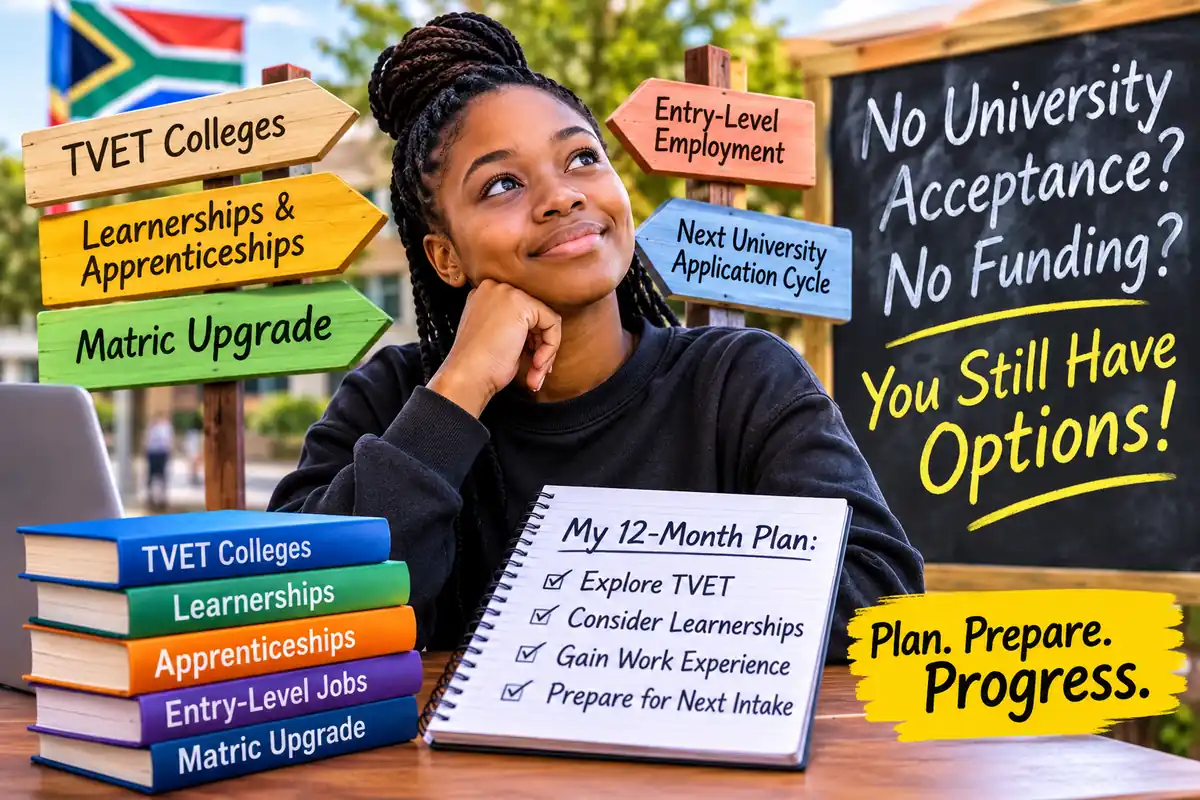
No University Offer / No Funding – What Can I Actually Do In The Next 12 Months?
Not getting into University is a huge blow after investing years into moving onto a higher level of education. However, on top of this if you are unable to afford the registration fees, haven’t got NSFAS funding or missed the application dates – it can be very stressful.
At this point, some learners can feel like they are stuck. All their friends are starting to talk about registering, accommodation and lectures. You may be doubting whether to wait, get a job or forget about studying.
You do have options!
By planning wisely you can make the most out of your next 12 months. Improve your matric results, go to a TVET College, complete an Occupational Qualification, apply for learnerships or apprenticeships, and earn an income whilst improving for your next chance of getting into University.
Try to avoid making costly decisions.
Identify why you cannot do what you would normally do.
Before applying to any more courses, make sure you know why you can’t do what you had planned. This will allow you to plan accordingly.
For example, if you do not have any funding but you meet the requirements for university then your plan will be different to someone who didn’t meet the marks in maths for their desired course.
If you meet the academic requirements but weren’t offered a spot – look at other institutions, courses and genuine late admissions.
If you were offered a spot but can’t afford to go – look at funding, public TVET Colleges and courses with funding.
If you didn’t get a good enough matric – look at rewriting subjects or improving your results through recognised exams.
If you’re unsure what you want to study – take the next few months to research careers, entry requirements and job opportunities.
Don’t just apply to courses that are open. These may not help you move towards your desired career and will waste your time.
Next Steps
- I meet the requirements for University but missed out.
Contact the admissions department for the Universities you are interested in. Ask if they have any courses with spots left, waiting list or late applications.
Some universities won’t allow late applications so be aware.
Check if:
- Your desired qualification is still taking applications.
- You meet the subject and point requirements.
- Are there any other courses with spots?
- Will your funding be affected by changing course?
- If there are no suitable options then use the next few months to prepare for your next application.
- University isn’t affordable.
Look at public TVET Colleges. These offer vocational and occupational courses which can lead to technical careers, business and practical careers.
NSFAS funding is available for qualifying students at eligible public universities and public TVET Colleges. Private colleges will not receive NSFAS funding. Your qualification will also need to meet the requirements.
Not all courses at TVET Colleges will be eligible for NSFAS funding. Contact the college to confirm.
- My matric isn’t good enough.
Look into the Second Chance Matric Programme offered by the Department of Basic Education. Don’t pay for private matric lessons.
This supports eligible candidates wanting to improve their results or meet the requirements for a National Senior Certificate or Senior Certificate. Support will be given through various methods including online resources.
Find out what specific subjects you aren’t meeting the requirements for. Improving one key subject may be more useful than rewriting multiple subjects when you don’t know what you want to apply for.
- I need an income.
Look into learnerships, apprenticeships, internships for school leavers and entry level jobs.
These can help improve your work experience.
TVET and Occupation Courses
There is a misconception that TVET Colleges are only for those who couldn’t get into University. This can cause school leavers to miss out on great career opportunities.
TVET courses can lead to careers in electrical engineering, business management, hospitality, engineering trades and other practical careers. Some colleges also offer occupation courses.
The most important thing to consider is whether the qualification will lead to the type of work you want to do and whether you have a genuine progression path.
Visit the Department of Higher Education and Training (https://www.dhet.gov.za/) to find public TVET Colleges. Find out about occupation courses.
If you’ve missed the usual application period then contact the colleges directly to ask if they have any spots left, alternative intakes and when the next application period is. Don’t visit the colleges assuming they’ll offer you a spot just because someone on social media says they have applications open.
Learnerships and Apprenticeships
If you can’t afford to do full time studies then work based learning is something to seriously consider.
A learnership will give you theory and practical experience. This will lead to an occupational qualification or partial qualification. Apprenticeships are perfect for those wanting to go into skilled trades. You will gain practical experience and be tested on your trade.
Look into:
- Electrical and Mechanical trades.
- Plumbing and building.
- Manufacturing and Engineering.
- Business Administration.
- Information Technology.
- Wholesale and Retail.
These can be very competitive. Not all courses will take people with no prior experience. Some will require certain matric subjects or age ranges.
Register with your nearest Department of Employment and Labour Centre as a work seeker. You can also contact relevant SETAs.
Never pay anyone who promises to get you a learnership. Make sure you know who the employer, training provider and qualification is.
Private Courses
As the deadlines are approaching you may be tempted by private training offers. They promise fast certificates, guaranteed jobs and qualifications that will get you into University.
Before paying ask for written answers to the following questions:
- What is the full name of the qualification?
- If it is an NQF registered qualification, what is its SAQA ID number?
- Which Quality Council accredits this course?
- Can you progress onto another course?
- Are there any extra exam, registration or certification fees?
- What practical training will you receive?
Just because an institution is registered doesn’t mean all their courses are accredited.
The QCTO website can help you find accredited skills development providers and occupational qualifications. The SAQA website explains how to check your qualifications and provider.
Useful websites
- QCTO: https://www.qcto.org.za/
- SAQA: https://www.saqa.org.za/
Be wary of expensive short courses that promise you a matric or University equivalence but don’t have any proof. A certificate of attendance may not be a nationally recognised qualification.
No Learnerships Available
There is nothing wrong with getting a job whilst preparing for your next admission.
Although you may not get a job in your desired career, getting an entry level job can help you gain skills that employers want.
Consider working as:
- Retail Assistants/Cashiers.
- General Administration Assistants.
- Receptionists.
- Warehouse Assistants.
- Customer Service Agents.
- Restaurant/Hospitality Assistants.
- Data Capturing Assistants (If you meet the requirements).
Getting a job can help improve your CV. Working with customers, colleagues, following instructions, time management and using systems can all help your CV.
If you get a job then set up a separate saving plan for your future studies. Even putting a little aside for application fees, travelling costs, registration fees or learning materials can help with your next admission.
Continue to apply for suitable learnerships.
12 Month Recovery Plan
Don’t let the whole year slip by. Break it down into sections. This isn’t a strict academic plan but you should adapt it depending on when you are applying and what opportunities are available in your province.
Months 1-2
Gather your matric results. Find out what courses you qualify for and contact institutions to see if they have any spots left.
If your marks aren’t good enough look into upgrading your matric. If it is funding related then find out what alternative public institutions and funding are available.
Months 3-4
Research TVET courses, occupation qualifications, apprenticeships and learnerships.
Find out what the entry requirements, length, costs and job opportunities are. Apply to suitable courses.
Months 5-6
If you aren’t studying or working then use this time to improve your practical skills.
Learn basic excel, professional communication, computer skills and CV writing. Try to use free learning resources.
Months 7-9
Research Universities and Colleges that offer your desired qualifications. Note down when applications are open, what subjects are required, minimum points and funding requirements.
Contact admissions departments if you’re unsure if your improved results or alternative qualification will meet their requirements.
Months 10-12
Apply to multiple suitable courses. Complete separate funding applications if required. Keep track of your applications.
Keep copies of your confirmation. Don’t assume that if you’ve applied for admission you’ve applied for funding.
Documents To Prepare
A common issue is having an opportunity but not having the documents ready.
Create a folder on your phone, computer or email. Add:
- Certified copy of your South African ID (if required).
- Matric Certificate or latest results statement.
- Academic transcripts (if applicable).
- Updated CV.
- Proof of address (if required).
- Parents/Guardian ID and proof of income (if asked for funding).
- Proof of application/acceptance (if applicable).
- Any relevant certificates and documents.
Ensure you have digital copies of these documents saved as PDFs. Make sure they are legible. Different institutions will require different documents to be certified and some will have expiry dates. Follow the instructions for each application.
Never send sensitive documents to unverified recruiters.
Don’t Waste A Year
Taking a gap year isn’t a bad thing. However don’t waste your year waiting for opportunities.
If you need to rewrite maths then do this first. If you can’t afford University then look into funded public courses. If you need work experience then start applying for entry level jobs and learnerships.
Be honest with yourself about what career you are interested in. Don’t sign up for a qualification just because you can. This can cause you another setback financially if you spend money on a course you have no interest in or doesn’t help you with your desired career.
Most importantly don’t compare yourself to your friends who got into University. Everyone’s situations, funding and academic journey will be completely different.
A final word for students who feel left behind
Not getting into University is disappointing but doesn’t define you.
There are many ways to continue improving yourself without going straight into a University classroom. Some may require you to go back to school to improve your results. Others may require practical training, work experience or starting at a public TVET College.
Make sure you make an informed decision.
Give yourself 12 months to improve your situation. Ideally by the time you get your next chance of getting into University you will have improved your qualifications, gained valuable experience, found realistic funding or have a better understanding of what career you want.
Even though you didn’t get the answer you wanted this year you can ensure that you are moving forward with your goals.